
A not so philosophical reflection on my life’s path as a circular journey home.

The villa and the circular path
I picture my life as a path that begins at an old Italian villa, leads out into the world and eventually returns to that same house. I think of it as my metaphorical birthplace. From there I set out on my path through life – at first with the house at my back and the world opening up in front of me, without a clear destination but with a sense of possibility. As I walk, the path reveals more and more forks and dead ends.
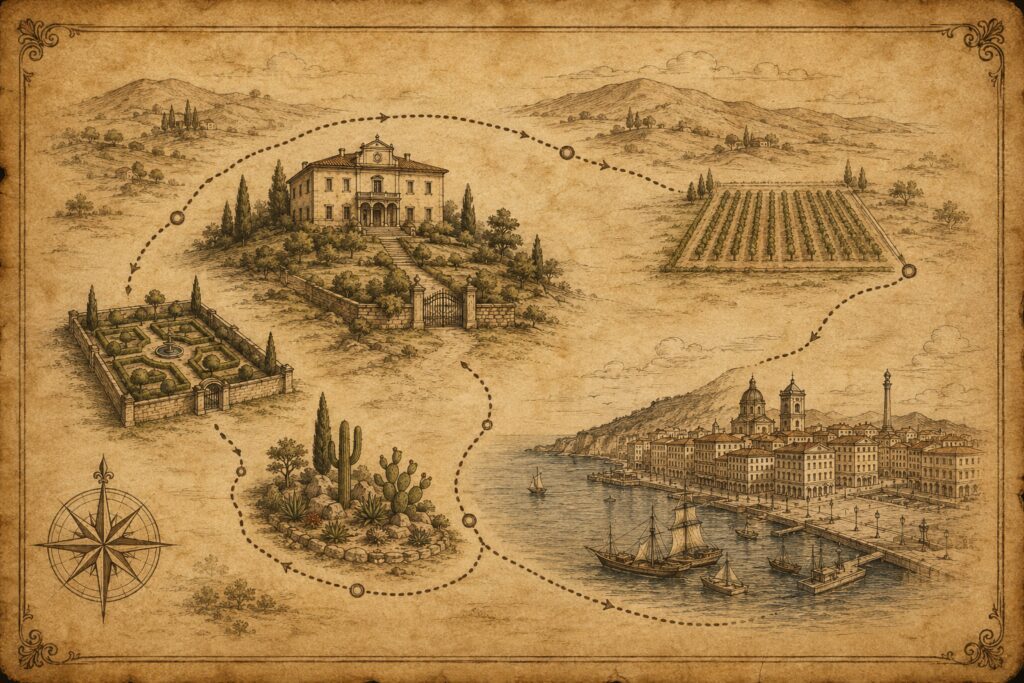
In the early part of this journey, the end of the path – death – is only an abstract idea, with finiteness far away. What matters are the turnings, the mistakes, the first experiences. You choose directions without yet grasping what it means that the path will, at some point, end.
After many years on the road, the path bends on a hill and the old Italian villa appears again in the distance. The way ahead is still long, but the end and destination of the journey have become visible. That brings both strength and calm. I still have ground to cover, but now I am walking towards something. For me, this is what growing older feels like – a quiet sense of peace that arises from becoming aware of my own finitude.
The last third: base camp and expeditions
In my early sixties I have the feeling that I have entered the last third of my path. A few years ago I bought an old villa in a small Italian village – without a concrete plan. The Italian dolce vita had always been a dream of mine. I began learning the language and getting acquainted with local bureaucracy.
This villa is not the house where my metaphorical life’s path began, but it has become an important station – more than property. It has become my base camp. It is where I run my longevity experiments. I ferment vegetables, have learned to work in the garden, to grow my own produce and to design a rock garden with cacti. I think about shapes, structures and textures, about how house and garden relate to each other.
These activities are contemplative, concrete and quiet – and they suit my growing tendency towards reclusion. They fill me and calm me. But they are not the end of my path; there are still things to discover.
From this base camp I have therefore launched new “expeditions”: setting up a field for an experimental longevity plantation right next to the villa, even though I know almost nothing about agriculture – something that can be learned. And then the project of an apartment in Trieste, about an hour away. I have always wanted to live by the sea.
I know these projects will bring stress: Italian bureaucracy, new structures, new risks – this is not a Zen garden. But I can feel that pure retreat would not be my way.
So I no longer see the last third of my life as a choice between contemplation and experiment, but as a consciously designed mixture:
Base camp: villa, garden, fermentation, living longevity, reclusion.
Expeditions: sea, city, projects, longevity field.
My inner protocol for the last third
To keep this mixture coherent for myself, I have given myself a simple inner protocol – not a rigid set of rules, but a kind of compass.
1. Only projects that fit my story
I only start projects that fit the narrative of my path. I ask myself:
“Can I express in a single sentence why this project makes sense on my way home – and is not just an escape from emptiness?”
If I cannot answer that clearly, it is probably mere activity for activity’s sake, not a genuine step along my path.
2. Every commitment needs an exit option
At my age, nothing begins “forever” anymore. Every new commitment needs a limit or an exit: in time (a trial period), in structure (a maximum time budget) or in practice (the option to sell, lease or hand it over).
My aim is not to avoid risk, but to avoid getting caught in constructions that end up dominating the last third of my life instead of enriching it.
3. After every ascent, back to base camp
After intense phases – in Trieste, at project peaks, in negotiations and bureaucracy – I do not jump straight into the next experiment. I consciously return to the villa. There I scale down: garden work, simple tasks, slow routines, few social obligations. The base camp is my regenerative counterweight, not just a backdrop.
Meaning as path, not as recipe
My metaphor is not a philosophical proof – it is a working model. I do not claim to have “found” the meaning of life. But I have found a way of thinking about my own finitude that does not tip into fatalism or esotericism.
For me, meaning is no longer located in some external fulfillment or grand finale. It lies in consciously walking the path itself – especially in the last third: in choosing and limiting, in experimenting and pausing, in returning home to my own base camp.
The house in the distance has become clearer. Whether it is cosmic, metaphysical or purely symbolic, I do not know – and I do not need to know. For my way home, it is enough that each step towards it feels more deliberate than it once did.
If this metaphor offers anything to the reader, I hope it is this: the courage to see the last third of one’s life not as a leftover stretch, but as a consciously shaped way home – with a self-chosen base camp and a few carefully chosen expeditions along the way.