
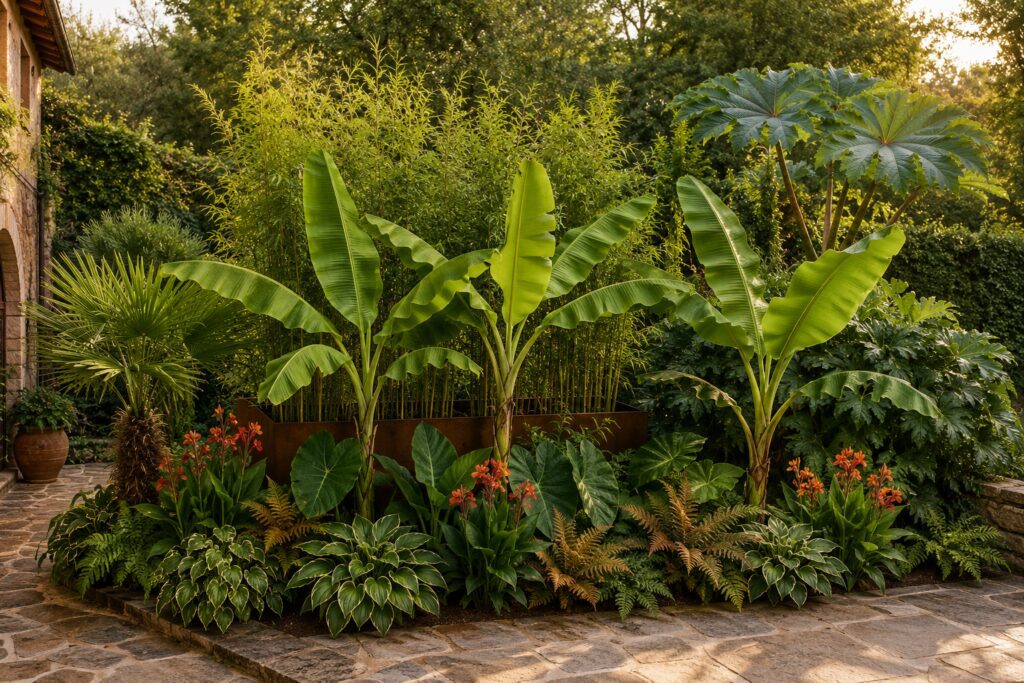
How a hardy banana grove, bamboo and bold foliage plants became the counterpoint to a stone garden in Friuli
I have always liked the quiet discipline of rock and gravel gardens – structure, texture, restraint. A few metres away from my new stone garden in Friuli, however, I wanted the opposite: a dense, exuberant jungle corner that feels almost tropical but survives a North Italian winter. The result is a 3×5‑metre experiment in controlled chaos built around hardy bananas (Musa basjoo), bamboo in Corten steel, and a supporting cast of bold perennials.
From longevity lab to Italian cottage garden
La Longevity is usually about blood markers, sleep data and metabolic experiments. This garden project is the analogue side of the same idea: creating a place that invites daily movement, manual work and sensory overload – sun, soil, water, scent. Over several years I want to develop what I call an “Italian cottage garden”: a loose, layered mix of Mediterranean structure (stone, herbs, fruit trees) and lush planting, instead of a sterile lawn.
The jungle corner is one of the anchor points of this plan. The hardscape is simple: a rectangular bed, three metres deep and five metres wide, bordering the terrace. Behind it, an existing hedge and trees form a natural green wall.
Perplexity: My enabling AI Partner
Along the way, I did not pretend to be a horticultural expert. Instead, I treated the garden like any other investigation and outsourced most of the missing domain knowledge to Perplexity, my AI assistant.
In practice that meant iterating through plant shortlists, checking winter‑hardiness and growth habits, balancing visual design with maintenance effort, and then turning the final selection into concrete shopping lists and a phased project plan. The jungle bed you see here – from Musa basjoo and Tetrapanax to Canna indica and Dryopteris erythrosora – is essentially a co‑design between human curiosity and machine pattern‑matching. Using AI this way allows me to open entirely new fields, like ornamental horticulture, and integrate them into my longevity strategy without spending years building traditional expertise first.
The backbone: hardy bananas and bamboo
At the heart of the planting are three Musa basjoo, the Japanese fibre bananas that are hardy enough to overwinter in the ground if the rhizomes are heavily mulched. They are positioned in a shallow arc towards the terrace so that, once mature, their leaves form a canopy above eye level. In good conditions Musa basjoo can reach 2–4 metres in height and spread into multi‑stemmed clumps, so each plant has about 1.5 metres of space around it.
Behind the bananas sits a long Corten steel planter filled with divisions of the bamboo that already runs through other parts of the garden. Instead of letting it behave like a weed, the raised metal bed acts as a built‑in rhizome barrier and turns bamboo into a controlled vertical screen. The rusty Corten colour picks up tones from the stone garden and visually ties the two areas together. Rhizome‑forming bamboo can be safely contained this way as long as the walls are continuous and at least 40–60 cm deep.
Jungle architecture: Tetrapanax, Fatsia and Trachycarpus
To avoid a flat “banana row”, I added a second layer of architectural foliage.
Tetrapanax papyrifer ‘Rex’ (rice paper plant) stands to one side behind the bananas, with giant hand‑shaped leaves that can reach 40–60 cm across in favourable conditions. In Central Europe it typically grows 2–3 metres high and gives exactly the primal, prehistoric feeling I was after.
Fatsia japonica, placed between bananas and bamboo, brings evergreen, glossy, palmate leaves and holds some structure in winter when the bananas are cut back and wrapped.
A small Trachycarpus fortunei (windmill palm) near the front edge provides a subtle palm silhouette without competing with the bananas for dominance.
This layered structure – bamboo wall, Tetrapanax and Fatsia in the middle, bananas in front – creates depth in only three metres of available space.
Ground layer: ferns, hostas and edible‑looking foliage
For the lower tier I chose plants that read as “jungle” but tolerate my climate and irrigation reality.
Dryopteris erythrosora (autumn fern) forms semi‑evergreen clumps about 50–60 cm tall with brick‑red new fronds that mature to dark green, giving subtle colour even in shade.
Several Hosta cultivars fill the slightly shadier pockets between bananas and shrubs; their broad leaves reinforce the lush look and are surprisingly compatible with warm climates when soil moisture is kept up.
Colocasia (elephant ear) is planned as a seasonal accent – in the warm months it adds large, upright leaves between the bananas, but can be lifted or protected in winter.
This understorey also acts as living mulch: once established, overlapping foliage helps shade the soil, stabilise moisture and reduce weeding.
Colour injection: Canna indica in red and orange
Up to this point the planting is overwhelmingly green. To break that, I ordered Canna indica cultivars with red and orange flowers. Cannas are warmth‑loving perennials with banana‑like leaves and tall flower spikes that bloom from mid‑summer into autumn if they get enough sun, water and nutrients.
Groups of three Canna plants will sit at the front corners of the bed – between the left banana and the Trachycarpus, and between the right banana and the Colocasia. That placement keeps the structure of the original design but adds hot colour exactly where the eye first lands when stepping onto the terrace.
Why this jungle matters for longevity
From a longevity perspective this project is more than decoration. It forces me to:
Spend time outside moving soil, lifting plants, hauling water – low‑intensity, habitual physical activity.
Create micro‑habitats for insects and birds, which in turn improves the sensory richness of the garden.
Build a long‑term project: the jungle will not be “finished” in one season, but will evolve over years, mirroring how health and resilience are built.
Next to the clean lines of the stone garden, the jungle corner embodies the other half of an Italian cottage ideal: a place that is slightly wild, productive for the ecosystem, and intensely alive.