How a 21,000 m² field, old tomato varieties, basalt rock dust, AI and a utility token became my next longevity experiment.
From garden to field lab
For years, my experiments in longevity have taken place in relatively small spaces: my villa, my garden, my kitchen, my Oura data. Now, the scale is changing.
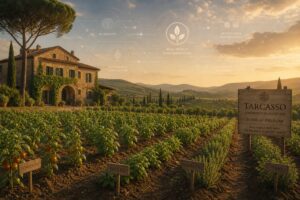
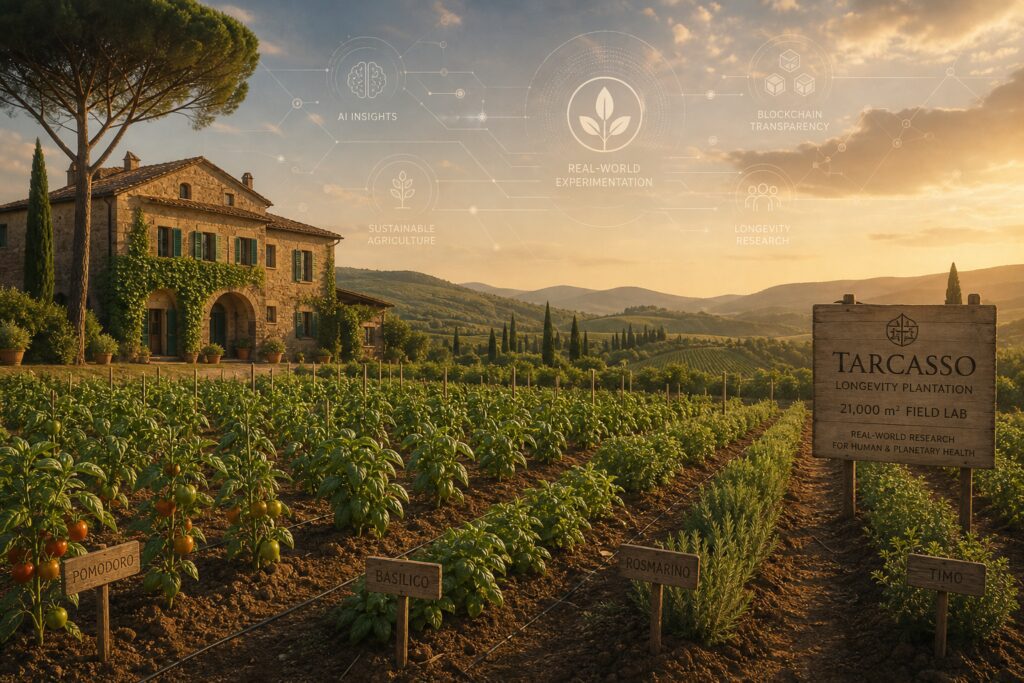
In late November 2026, I will take over a 21,000 m² field from local farmers. On this land I want to create an experimental “TarCasso Longevity Plantation” – a field lab for old tomato varieties, chili and herbs, grown in a way that connects soil health, human health and technology. It is the logical next step on my personal path: from the raised bed behind the house to a real piece of agricultural land, together with local farmers who understand the soil far better than I do.
Details of the project, including field layout and progress, will be documented on the dedicated site: https://tarcassofieldlab.com/.
Basalt rock dust and soil as a longevity lever
One core element of the project is basalt rock dust, supplied via our cooperation with Balkan Basalt and integrated through the Flour Yield ecosystem. Scientific work on basalt rock powder (BRP) and rock dust suggests that it can act as a soil remineralizer, improving pH and increasing the availability of nutrients like calcium, magnesium, phosphorus and potassium, with positive effects on plant growth and soil health.
Field and greenhouse studies report higher dry mass production, better nutrient profiles and, in some cases, higher Brix levels and yields in crops like tomatoes grown with basalt rock dust compared to controls. In other words: rock dust is a way to feed the soil so the soil can better feed the plants – and potentially improve the nutritional quality of what eventually ends up on our plates.
For a longevity project, that is an attractive lever: instead of only looking at supplements and biomarkers, TarCasso starts one level deeper – in the ground.
Flour Yield Token, MiCA and a real-world utility
The TarCasso Longevity Plantation is also part of the Flour Yield project, which uses the FYT utility token as a MiCA-compliant crypto-asset to support soil-health and basalt-based projects. FYT is designed as a utility token within the Flour Yield ecosystem, used for access and payments rather than as a pure speculative asset, with a regulatory framework aligned to the EU’s Markets in Crypto-Assets (MiCA) regulation.
Integrating FYT into the TarCasso field lab means that this is not just another “token story”, but a real piece of land, real basalt rock dust and, if all goes well, real tomatoes, chili and herbs. Blockchain and regulation become background infrastructure, not the star of the show.
AI as co-pilot in the field
I am not a farmer. I am a gardener with some experience in tomatoes, chili and herbs – and someone who likes to build systems and experiments. For the TarCasso Longevity Plantation I will depend on local farmers for operational know-how and machinery, while using AI as a co-pilot for:
planning crop rotations and varietal choices,
interpreting soil, weather and plant data,
documenting the project in a transparent, structured way on tarcassofieldlab.com,
and connecting agronomy questions with longevity questions (nutrient density, processing, usage in a longevity lifestyle).
On my personal “life path”, this plantation is a new kind of expedition: not a digital project, not just a blog article, but a living experiment out in the field.
A next step on my longevity journey
The TarCasso Longevity Plantation brings several threads together:
Sustainability – remineralizing soil with basalt rock dust and working with local farmers instead of treating land as an abstract asset.
Longevity – focusing on crops and cultivation methods that could support a healthier, more nutrient-dense diet.
AI – using artificial intelligence not as a gimmick, but as a tool to plan, monitor and learn.
Blockchain and regulation – integrating a MiCA-compliant utility token (FYT) into a concrete, physical project instead of yet another purely virtual use case.
For me, this is a natural next chapter. It is still experimental, still open-ended, and still part of a journey rather than a finished concept. If you want to follow the more technical and agronomic side of the project, you will find it on the dedicated field lab site: