

If you had told my 40-year-old self that one day I’d obsess over the tiny gaps between my heartbeats, he would probably have laughed, ordered another beer, and changed the subject.
Fast-forward to 62: an Oura Ring now lives on my finger, artificial intelligence has become a regular sparring partner, and a metric called heart rate variability — HRV for short — has turned into one of the most useful signals in my longevity routine. Oura reports HRV as RMSSD, a nighttime metric in milliseconds that reflects how adaptable and well-recovered the autonomic nervous system appears to be.
What changed in my data
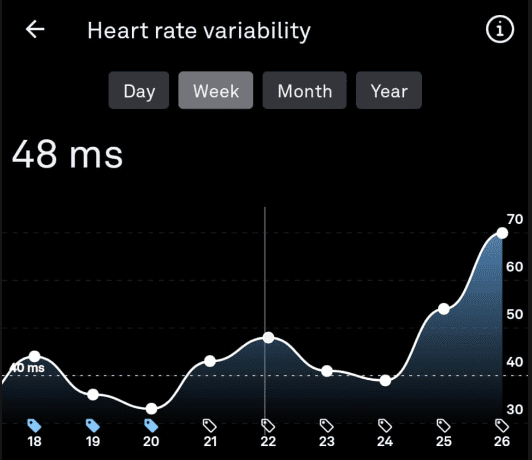
At the beginning of the year, my average nightly HRV was below 40 ms. Over the last weeks, the weekly value climbed to around 70 ms, which is already an unusually strong number for someone aged 62.ouraring+2
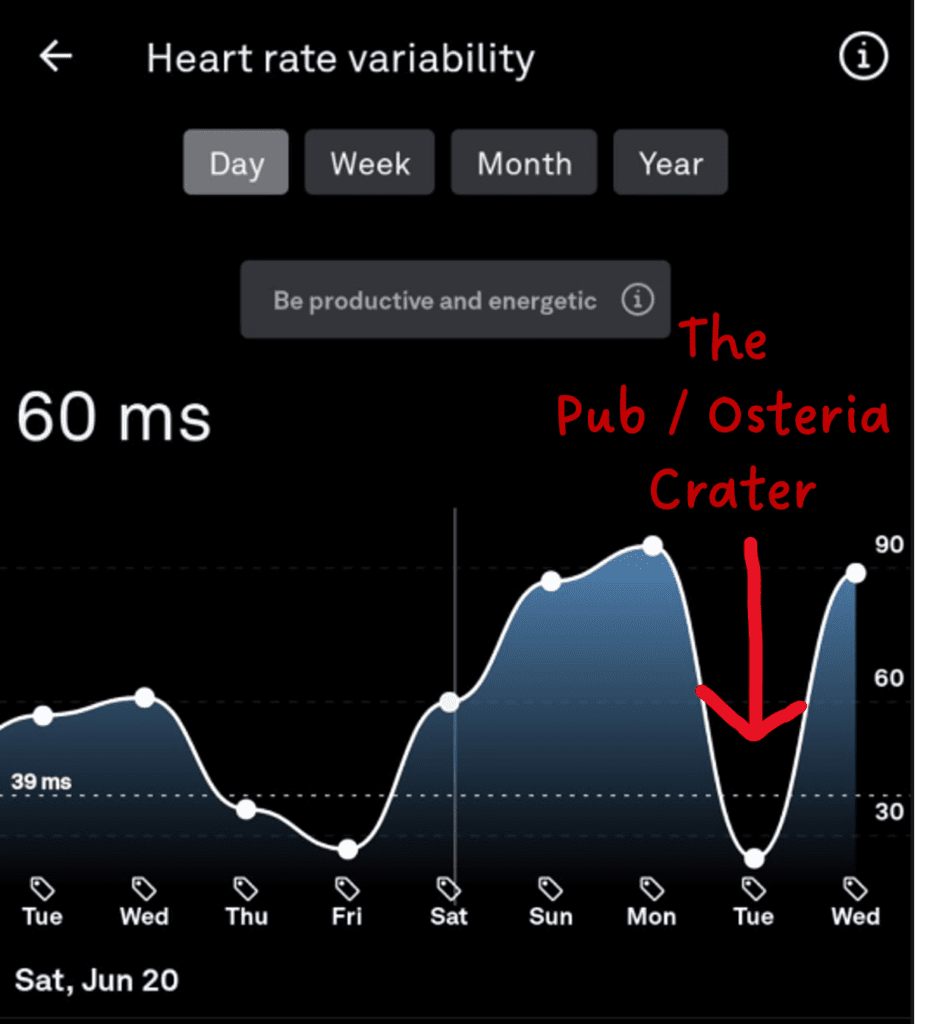
The newest daily Oura view made the pattern even clearer. Several pub / ostaria-free days produced HRV values above 80 ms, and then one pub day smashed the next night down to about 25 ms. That is not a mild wobble. From 80 to 25 ms, the drop is closer to 69% than 15%, which is why the chart looks less like a health graph and more like an Alpine ridge followed by a cliff.
The screenshots show the same weekly rhythm again and again: strong climbs on alcohol-free, active days, then abrupt collapses after beer or wine-tagged evenings. No binge drinking, just a few glasses of wine or beer in the evening until around 9:00 p.m. Which is actually rather early for Italy. In other words, the data is not subtle.
The pub / osteria leaves strong fingerprints.
What changed in my life
Several variables changed at the same time, which is exactly why wearable data becomes more useful when combined with interpretation rather than treated as a fortune cookie.
Weekly movement more than doubled, mainly through cycling and long stretches of physical garden work.
Pub days were reduced from 3-4 per week to a maximum of two.
Carbohydrate intake dropped significantly, with very little pasta or bread.
Daily food now often includes 3–4 eggs, meat, and fish.
Lunch regularly includes a spoonful of tomato paste with extra virgin olive oil.
Magnesium and omega-3 supplementation became part of the routine.
Taken together, this created a useful personal question: which one of these changes likely explains most of the HRV improvement?
What the analysis showed
The strongest answer was movement. Reviews and training studies consistently show that regular endurance-type activity improves HRV over time, and dose matters: when overall exercise volume rises meaningfully, HRV often rises with it.pmc.ncbi.nlm.nih+3
That fits this case almost suspiciously well. Cycling, gardening, stairs, and generally moving much more than before form the kind of steady aerobic background that tends to raise resting parasympathetic tone and therefore nighttime HRV.
Alcohol, by contrast, appears to be the most reliable destroyer of otherwise beautiful graphs. Oura analyses report that alcohol-tagged nights are associated with an average HRV decrease of roughly 10.8 ms, or about 15.6%, together with higher nighttime heart rate and less restorative sleep.
My own pattern looks even more dramatic than the community averages. On good days the graph climbs above 80 ms; after a pub day it can fall to 25 ms. That suggests the real value of reducing pub days was not moral purity but damage control: fewer weekly autonomic crashes allowed the positive signal from exercise to become visible.ouraring+2
Diet and supplements likely helped, but probably as supporting actors rather than the lead. Omega-3 has been linked with modest improvements in vagal activity and HRV, while Mediterranean-style eating patterns are associated with better autonomic profiles; low-carb eating itself is not a guaranteed HRV miracle and may work more through metabolic health than through carbohydrates alone.pmc.ncbi.nlm.nih+2
Why AI matters here
This is where the interesting part begins. A wearable can collect data beautifully, but data alone is often just an elegant form of confusion.
Without AI, this kind of interpretation would require a tedious amount of reading across wearable validation studies, Oura community findings, alcohol research, exercise physiology, and age-related HRV benchmarks. With AI, the screenshots, habits, and questions can be turned into a coherent analysis within minutes, including interpretation, probability ranking, and practical next steps.
That matters because the point is not merely to admire numbers. The point is to build a feedback loop: collect the signal with technology, analyze it with AI, and then adjust real-world behavior in a way that still feels human.
The price of the lifestyle
This may be the least Instagrammable insight in longevity culture: the body keeps accounts, even when the mind calls it social life.
The pub days are still there, just fewer and more deliberate. They are not an oversight in the system; they are the negotiated cost of a lifestyle that aims for longevity without becoming a monastery with better lighting.
The data makes that trade-off measurable. A pub-free week rewards me with days above 80 ms. A pub night can produce an HRV crater around 25 ms the very next day. That is not a judgment. It is simply the bill arriving in biometric form.
So the current strategy is not “never have beer (or wine) again.” It is much less heroic and probably more sustainable: keep pub days to one or two per week, avoid stacking them if possible, and treat the following day as recovery territory rather than pretending physiology is open to negotiation.
What I take from this at 62
For men in the early 60s, average HRV values are often far below the numbers now showing up in this Oura data, and values above roughly 60 ms are often described as excellent for the age group.