Discovering forest bathing as a longevity experiment
Every now and then, something crosses my path that feels familiar and surprising at the same time. Recently it was a video about trees “emitting substances” that can boost our immune system. My first reaction was the usual: Is this science or esoteric storytelling?
Digging into the literature, I realized there is a solid scientific core behind the romantic language. Trees do release volatile compounds – phytoncides – to protect themselves from insects and pathogens. And there are human studies suggesting that these substances, together with the forest environment itself, can measurably influence our immune system.
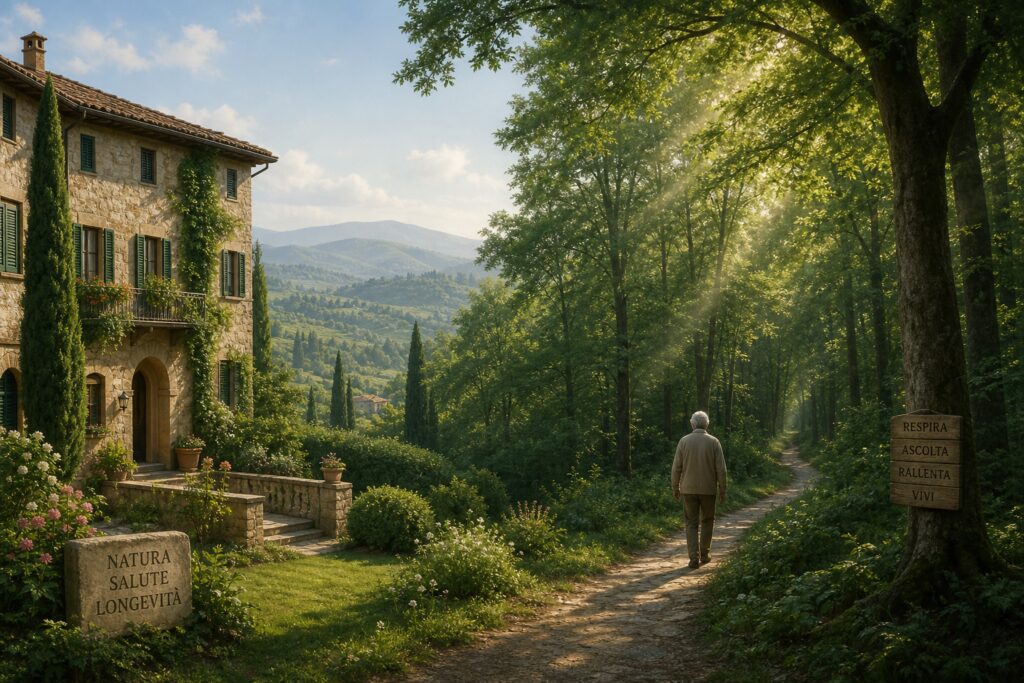
For someone who has defined late life as a “way home” and sees longevity as a path rather than a hack, this was too interesting to ignore. So I decided to treat forest bathing as another experimental module on my longevity path – alongside sleep, nutrition, fermentation, and my work in the garden.
What phytoncides are – in plain language
Phytoncides are volatile organic compounds (mostly terpenes such as α‑pinene, β‑pinene, limonene) released by trees and other plants. They act as a kind of chemical defense system: protecting the tree against insects, fungi and microbes.
We inhale these compounds when we walk through a forest with rich tree cover. They are measurable in forest air and can also be introduced experimentally, for example by diffusing tree essential oils in a room.
From a longevity perspective, the interesting question is simple: Does exposure to these substances – in a real forest or via their extracted oils – do anything meaningful to our immune system?
What the Japanese forest-bathing studies actually found
The best-known work comes from Qing Li and colleagues in Japan, who systematically studied “forest bathing trips” (Shinrin-yoku) and immune function. A few highlights that convinced me this is more than wellness marketing:
In one study with male office workers, a 3‑day/2‑night trip to forest areas significantly increased the activity of natural killer (NK) cells, as well as the number of NK cells and the levels of intracellular anti-cancer proteins like perforin, granzymes and granulysin.
This increase in NK cell activity lasted more than 7 days, and in some analyses even up to 30 days after the forest trip.
A controlled comparison showed that a trip to a city did not produce these changes – suggesting that it is not just “time off” or tourism, but something specific about the forest environment.
Similar results were found in female subjects: forest bathing trips increased NK activity, NK cell numbers and anti-cancer protein levels, and the effect again persisted for at least a week.
To test whether tree-derived compounds themselves were a key factor, the researchers designed another elegant experiment:
Healthy men stayed at an urban hotel for 3 nights, but the room air was enriched with phytoncide-containing oils from trees.
Phytoncide exposure significantly increased NK activity and the percentage of NK cells expressing perforin, granulysin and granzymes A/B, and significantly reduced adrenaline and noradrenaline levels.
A more recent systematic review and meta-analysis on phytoncides and immunity reported overall favourable immunological outcomes, including increased NK cell activation and cytotoxic effector molecules, with a pooled effect size for NK activation that was clearly significant.
For me, this was the point where forest bathing moved from “nice idea” to “serious candidate for a structured longevity practice”.
My personal “forest-bathing protocol” (experimental)
True to my “path” metaphor, I do not want a rigid prescription, but a protocol I can test and adjust. Based on the Japanese data, a reasonable starting point seems to be:
Frequency: Aim for at least one forest immersion per month, ideally more. The original studies suggest that a 2–3 day trip can keep NK activity elevated for 7–30 days.
Duration: On “normal” forest bathing days, aim for 2–4 hours of slow walking or sitting in a forest environment, focusing on relaxed breathing rather than exercise performance.
Environment: Mixed or coniferous forests with rich tree cover, where phytoncides like α‑ and β‑pinene are more abundant.
Mode: This is not hiking as a sport. It is more like open, relaxed presence: walking, standing, sitting, smelling, feeling the air, with phone and performance metrics kept to a minimum.
I will treat this as a running longevity experiment on myself, not as a belief system. The questions I am interested in are:
How does regular forest exposure influence my subjective stress levels, sleep and recovery?
Welche Muster sehe ich in meinen eigenen Biomarkern (z.B. Entzündungsmarker, HRV, vielleicht auch gelegentlich NK-Parameter, falls praktikabel)?
Wie fügt sich das in mein vorhandenes “Basislager”-Konzept aus Villa, Garten, Fermentation und Reklusion ein?
Between science and story
Forest bathing sits in an interesting space between data and narrative. On the one hand, there are hard outcomes: NK cells, anti-cancer proteins, stress hormones, systematic reviews. On the other hand, there is the simple, old story: humans belong under trees from time to time.
For my longevity path, that combination is exactly right. I do not need guaranteed extra years. What I want is a way of living in this last third that respects biology and still feels like my own story.
Forest bathing – with its mix of phytoncides, silence, movement and light – now becomes one of the “expeditions” I add to my path. Not as doctrine, but as an ongoing, curious experiment.
If you are on your own longevity journey, you might consider the same stance: not “forest bathing as the answer”, but forest bathing as a question you can explore with your own body, your own nervous system, your own sense of homecoming under the trees.